
Who Clears Land in Lancaster, SC, and How to Hire One
Land in Lancaster County gets cleared by forestry mulching operators, grading and site-work companies, tree services, loggers, and farmers with a skid steer on the side. South Carolina licenses some of that work and not the rest. Here is where the state draws the lines, how to look up a license, what insurance to ask about, and what to settle in writing before anyone starts.
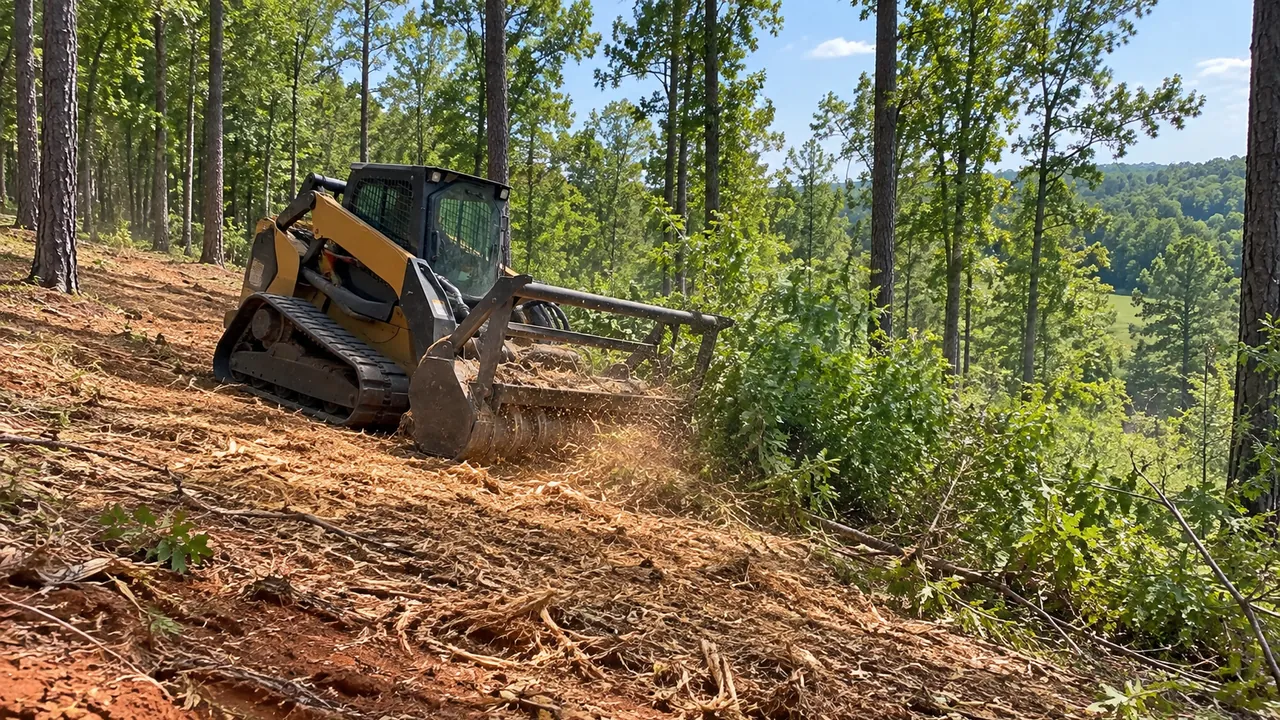
Does land clearing need a license in South Carolina?
Clearing by itself, usually not. The Contractor's Licensing Board at the SC Department of Labor, Licensing and Regulation (LLR) publishes a list headed "Non-Regulated Work - No License Required," and "Land Clearing / Grubbing" is on it, along with landscaping (LLR list, revised July 2023).
Grading is another matter. State law makes grading one of the Board's license classifications and defines it as "the soil preparation and rehabilitation of streets, roads, highways, railroad beds, building sites," among other things (S.C. Code § 40-11-410). A general contractor license is required when "the total cost of construction is greater than ten thousand dollars" (§ 40-11-30); LLR's 2023 update notes the line moved up from $5,000. The no-license list carries its own warning: regulated parts of a mixed job may still need that license once they cost more than $10,000.
On a typical Lancaster County job, that sorts out like this:
- Clearing brush and trees off a field, a woodlot, or a homesite, grubbing included, fits the "Land Clearing / Grubbing" entry on LLR's list.
- Grading a house pad or building site is grading work. Once that part of the job tops $10,000, it can require a general contractor license carrying the grading classification (GD). Clearing a house site walks through the steps on a homesite.
- Tree removal, stump grinding, bush hogging, and forestry mulching don't appear on the list under those names. If one of them is the whole job and the price is large, ask the Contractor's Licensing Board, (803) 896-4686, whether a license applies.
Homebuilding answers to a different board. Under S.C. Code § 40-59-20, the Residential Builders Commission licenses residential builders on jobs over $5,000 and residential specialty contractors on jobs over $500, but the specialty trades it names (plumbing, electrical, HVAC, roofing, masonry, and the like) don't include clearing, grading, or site work. Both licensing chapters also exempt an owner of residential property who improves it (§ 40-59-260, and § 40-11-360, which limits the exemption to the owner's own use rather than sale or rent).
How to look up a contractor's license
- Ask for the license number and the exact business name. Someone who holds a license can give you both on the spot.
- Search the Contractor's Licensing Board records on LLR's contractor license lookup.
- Check that the license is active, and if grading is part of the job, that its classifications include grading (GD).
- If the company doesn't turn up, or you need to check a residential builder's license instead, call the Contractor's Licensing Board at (803) 896-4686 and ask where to look.
Since land clearing is on the no-license list, an operator without a license number isn't necessarily breaking a rule. For that work, insurance and a clear written scope tell you more.
Insurance to ask about
Clearing brings heavy machines, falling trees, and sometimes fire onto your land, often on slopes, beside fences with cattle behind them, or near a well. Before work starts, ask for:
- A certificate of general liability insurance sent by the contractor's insurer, naming you as certificate holder for this job. This is the coverage that answers when a tree lands on a barn, a track cuts a well line, or a burn pile escapes. Read the dates and the limits yourself.
- Workers' compensation for anyone working on your land, or a clear explanation of why it isn't carried. Ask a logging crew cutting timber first the same questions.
Contractors are responsible for their own licensing and insurance, so get the paperwork, not a promise over the phone.
Questions to ask before you hire
- Is any part of this job grading? If so, what's your license number?
- Will your insurer send me a liability certificate, and do you carry workers' comp?
- Which areas will you mulch, which will you grub, and why?
- What happens to the brush? If it's burned, who calls the Forestry Commission at 1-800-705-8610, and how will the fire meet the 1,000-foot rule? (See burning land clearing debris.)
- Who requests the SC811 locate, three to twelve full working days ahead?
- Who files any SC DES stormwater notice, and who keeps the silt fence up until the clay is covered?
- What keeps the machines away from the drainfield area, the well, and the trees I'm saving?
- What do you do when the clay is soaked: wait, or work through it?
- How many machine days do you expect, what's the rate if it runs over, and how much is the deposit?
What a written agreement should cover
For work the state doesn't license, the paper you sign is most of your protection. It should spell out:
- The work area, marked on a map or flagged on the ground, and what's excluded: keeper trees, the drainfield area, stream zones, fences.
- The method for each area, and the depth for any stump grinding.
- Where the debris goes, whether silt fence and seed are included, and who handles burn notice, SC811, and any stormwater filing.
- The price and how it's figured (per acre, per day, or per hour), the rate for extra time, and the payment schedule. The cost guide explains how to compare the three.
- A start date, an expected finish, and the plan for wet weather.
- A copy of the insurance certificate, and the license number if grading is part of the job.
Keep the deposit modest and tie later payments to finished work you can see. Paying in full before the machine leaves gives up your leverage.
Red flags
- Cash only, the full amount up front, or a price that's good only today.
- No written quote, or one that just says "clear lot."
- An insurance certificate that comes from the contractor rather than the insurer, or none at all.
- Talk of burning beside the road, during the county's May-through-September ban without checking whether your parcel is exempt, or without a call to the Forestry Commission.
- Telling you no 811 call is needed before grubbing or grinding.
- Plans to clear right down to a creek bank. The permits guide explains the stream buffers.
Hiring questions
Is a tree service the same as a land clearing contractor?
Usually not. Tree crews specialize in single trees, often over a roof or a driveway, using climbers and bucket trucks. Land clearing outfits work acreage with mulching heads, excavators, and dozers. Some do both.
Who should I talk to before selling timber?
The Forestry Commission keeps a list of consulting foresters, each required to employ a registered forester, and a "Before you sell your timber" page. Talk to one before any clearing starts, so marketable trees aren't ground into mulch. Clearing land after logging covers what comes next.
Do I need a license to clear my own land?
Not for clearing on LLR's no-license list, and both licensing chapters exempt an owner improving their own residential property. The other rules still apply to you: SC811 before mechanized digging, burn notice, and SC DES stormwater rules where they reach your project.
The lowest bid comes from someone with no license. Does it matter?
For clearing and grubbing, LLR's list says no license is required, so judge the bid on insurance, a clear written scope, and how the questions above get answered. If the job includes grading over $10,000, it does matter, because that part of the work can require a general contractor license.
How we help
We introduce you to one independent contractor who takes work in your part of Lancaster County. Contractors are responsible for their own licensing and insurance, so ask the questions on this page and use the LLR lookup if grading is involved. A referral is an introduction, not a guarantee. They walk the land and put a price in writing, and the choice is yours. There's no charge for the referral.
Want a local contractor to walk your land?
Call or send a short request. There's no charge for the referral.