
Land Clearing Permits, Buffers & Burn Rules in Lancaster County, SC
Do you need a permit to clear land in Lancaster County? It depends less on the machine than on where the land sits and what you're clearing it for. The county's published erosion permit thresholds (starting at 10,000 square feet of disturbance) are set out for its regulated stormwater area north of SC-5. Across the rest of the county, SC DES handles construction stormwater, and the county's ordinance has a separate section on erosion permits outside the regulated area, so call County Stormwater before a sizable job. Burning outside town limits means a call to the Forestry Commission, a house on septic needs a state site evaluation first, and a few creeks here carry an endangered mussel. Below, each rule is organized by what you're doing, with its threshold, the office that decides, a phone number, and a link. Checked October 2026.
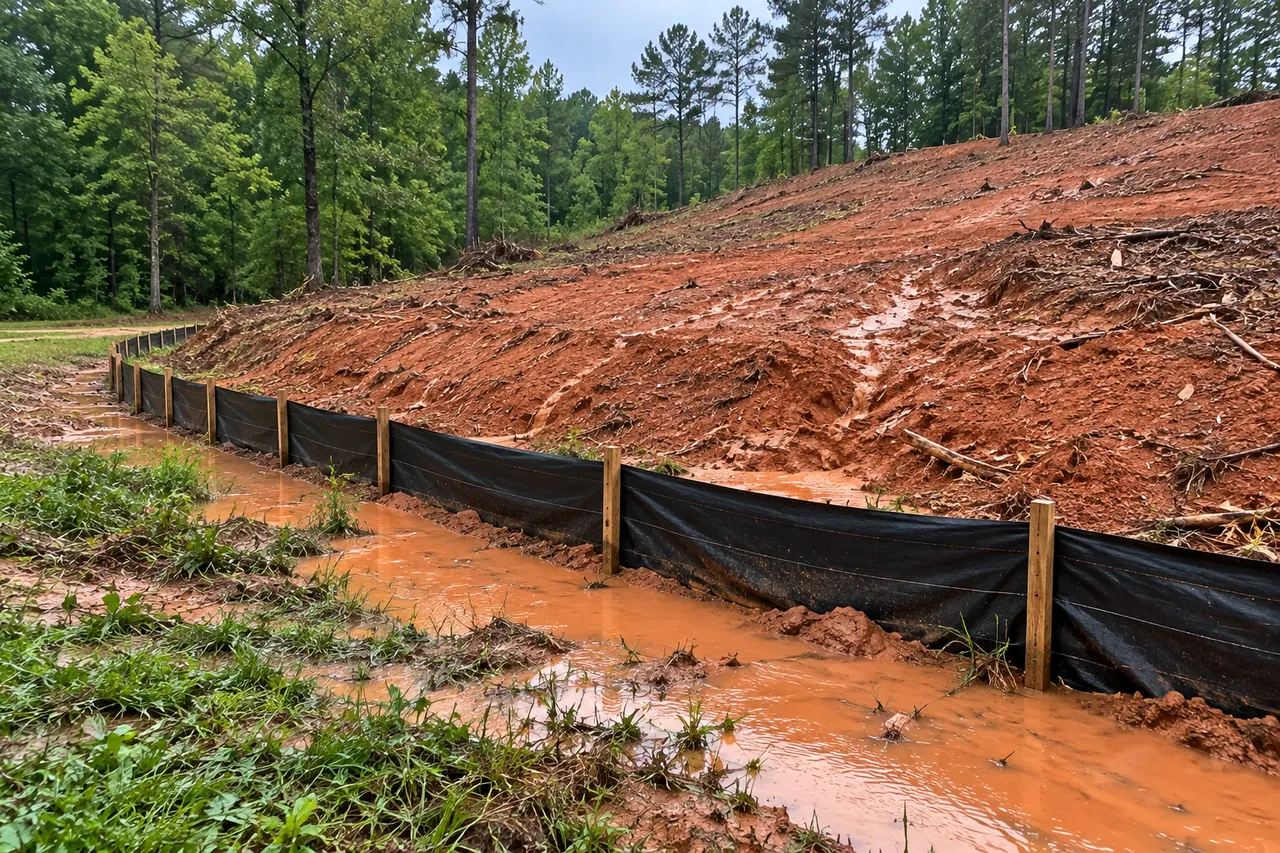
The short version
| If you are... | Then... |
|---|---|
| Clearing or grading north of SC-5, in the county's regulated stormwater area | County Erosion and Sediment Control Permit at 10,000 square feet of disturbance; a Minor Stormwater Permit for 1 to 2 acres; a Major Stormwater Permit over 2 acres. County Stormwater Management, 803-286-3607. |
| Clearing or grading anywhere else in the county | SC DES runs construction stormwater: a notification form under 1 acre, Construction General Permit coverage from 1 acre, a Notice of Intent over 2 acres. Ask County Stormwater whether a county permit applies too. |
| Clearing for farming or forestry, or for one separately built house | Exempt from the state sediment law. For a house site over an acre, ask SC DES whether state permit coverage is still needed. |
| Working near Flat Creek, Gills Creek, or the Lynches River | Stretches of all three are federal critical habitat for the endangered Carolina heelsplitter. Keep mud out of the water and the streamside trees standing. |
| Developing land along a stream, pond, or river | The county's development ordinance requires undisturbed buffers: 30 or 50 feet along streams, 30 to 50 feet around ponds and wetlands, 100 feet along the Catawba and Lynches rivers, and at least 100 feet where threatened or endangered species are present. Ask Planning, 803-285-6005. |
| Inside the Town of Van Wyck | Buffers of at least 20 feet on each side of perennial streams and wetlands under the town's own ordinance, which also adopts the county's Chapter 8 (administered by Lancaster County), so the county's wider buffers can apply too. Tree permits for protected trees, with house lots and farm and forest land excluded. Town, 803-712-4993; County Planning, 803-285-6005. |
| Burning clearing debris outside town limits | Call the Forestry Commission's Lancaster County line, 1-800-705-8610, meet the SC DES land-clearing burn conditions, and mind the county's May-through-September ban on land-clearing burns. |
| Building a house on septic | SC DES site evaluation ($150) before construction. Mark the lines and stake the house first (DES may require underbrush cleared), and hold off grading the likely drainfield area until DES has looked. |
| Digging or grubbing (and, to be safe, stump grinding) | Notify SC811 three to twelve full working days ahead. |
| Harvesting timber | No county permit on qualifying forestland. Follow the Forestry Commission's voluntary 40-foot streamside zones. |
Clearing and grading: north of SC-5 or not?
Start here, because it decides which office you deal with. Lancaster County's Stormwater Management Plan (issued 2015, last revised 2019) sets its regulated stormwater area as the "Lancaster County Panhandle (North of SC-5)," a 58.3-square-mile area. The county's stormwater page notes that the Indian Land portion of the county counts as part of the Charlotte urbanized area. Inside that area, the plan calls for:
- An Erosion and Sediment Control Permit "for any development which disturbs 10,000 square feet or more."
- A Minor Stormwater Permit for sites disturbing between 1 and 2 acres, and a Major Stormwater Permit above 2 acres.
- A stormwater pollution prevention plan for land disturbance of 1 acre or more, or less if the site is part of a larger common plan.
Outside that area, which covers most of the rural county (check the county map if your land is close to SC-5), the county's stormwater FAQ says the state agency "will remain the stormwater inspection/observation service for the approximate 500 square miles of rural areas." (The FAQ uses the old name, DHEC; those programs now sit with SC DES.) The county's development ordinance also has a section on erosion permits outside the regulated area (UDO § 8.5). Before a sizable job, call County Stormwater Management at 803-286-3607 (8451 Charlotte Highway, by appointment, weekdays 8:30 to 4:30) and ask what that section requires for your parcel.
The state construction stormwater rules
SC DES issues the state's construction stormwater permit. The current permit, SCR100000, took effect March 30, 2026 and runs to March 30, 2031, per the DES fact sheet. By size of the disturbed area:
- Under 1 acre. DES's small-site page says a Notification Form for Sites Disturbing Less Than 1 Acre (DHEC Form 2628) goes to DES for review. If DES decides permit coverage isn't needed, it sends a letter of exemption saying "the proposed land disturbance may begin." A lot in a larger common plan, such as a subdivision, may need the full Notice of Intent at any size.
- 1 to 2 acres. DES's 1-to-2-acre page says clearing, grading, or excavating that disturbs "between 1.0 acres and 2.0 acres" needs coverage under the Construction General Permit before work starts. The new permit's fact sheet words it as "greater than one acre," so if your site is right at an acre, ask DES which applies.
- More than 2 acres. A Notice of Intent goes to DES before land disturbance begins (DES page).
Fees. DES's fee page lists a $125 standard review fee for projects that need general permit coverage, "plus an additional $10 per 1/10 of an acre up to a maximum of $2000," for a maximum of $2,125. For a 3-acre site, that works out to $125 plus 30 tenths at $10, or $425 (our arithmetic, not a published figure). Ask DES whether the fee applies to a 1-to-2-acre site.
Farm, forestry, and single-house exemptions
South Carolina's stormwater and sediment law (S.C. Code § 48-14-40) exempts three kinds of clearing that matter here:
- Agriculture: "Land disturbing activities on agricultural land for production of plants and animals useful to man." It doesn't cover building an agricultural structure of an acre or more when a building permit is required.
- Forestry: work "undertaken on forest land for the production and harvesting of timber and timber products."
- Single houses: "single family residences or their accessory buildings which are separately built," but not houses built as part of a subdivision.
If your house site will disturb more than an acre, put one question to SC DES before you clear: does that single-house exemption also remove the need for state construction permit coverage? The DES permit pages speak of "anyone engaged in clearing, grading, and/or excavating" and list no single-house exception. DES lists its stormwater staff on its stormwater contacts page. Get the answer in writing.
Clear-cutting land you plan to develop. South Carolina's 2009 Right to Practice Forestry law (Act No. 48) bars counties from regulating forestry on qualifying forestland, such as land taxed at its forestry use value or managed under a forest plan. In exchange, it lets a county put off considering a development application for one year after a harvest that removed all or substantially all of the trees, or five years if the harvest was a willful violation of county rules. Before you log land you plan to build on, ask County Planning (803-285-6005) whether the county applies that waiting period.
Creeks, buffers, wetlands, and floodplain
The Carolina heelsplitter. This freshwater mussel has been federally listed as endangered since 1993 (U.S. Fish and Wildlife Service). The federal critical habitat rule of 2002 names three stretches in and along Lancaster County: about 11.4 miles of Flat Creek from the S.C. Route 204 bridge down to the Lynches River; about 14.6 miles of the Lynches River from the mouth of Belk Branch down to the S.C. Highway 903 bridge in Kershaw County; and about 6 miles of Gills Creek east of the city of Lancaster, down to the S.C. Route 51 bridge. The mussel needs "Stable substrates with no more than low amounts of fine sediment," and the rule says "Construction and land-clearing operations are particularly detrimental" when they alter floodplains or strip forested stream buffers. SCDNR calls Flat Creek's population "the only remaining population showing signs of recent reproduction" (SCDNR).
In practice, that means red clay mud is the threat. Leave the trees along the bank, keep bare ground well back from the water, and get silt fence or straw up before rain if you're clearing a slope that drains to one of these creeks.
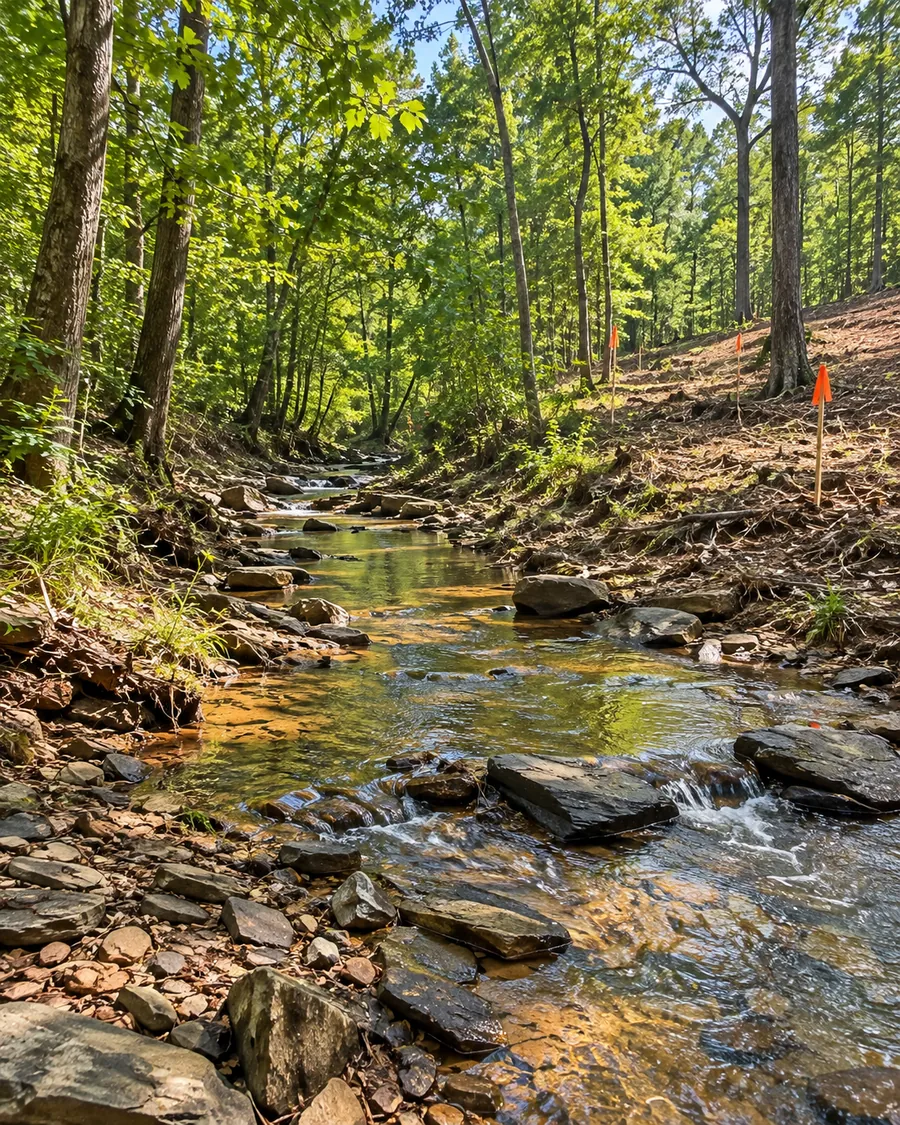
The county's heelsplitter overlay (UDO Chapter 4) covers only the Six Mile Creek basin in the panhandle, not Flat Creek. There, native forested buffers of 200 feet along perennial streams and 100 feet along intermittent ones are measured from the top of the bank.
County stream, pond, and river buffers. The county's development ordinance (UDO Chapter 8, adopted 2016, § 8.6.3) requires undisturbed buffers along streams and around ponds and wetlands:
- Streams draining more than 20 acres but less than a square mile: at least 30 feet on each side. More than a square mile: at least 50 feet on each side.
- Ponds and wetlands: 30 feet around those over a tenth of an acre, 40 feet from 1 acre, and 50 feet from 2.5 acres.
- "Buffers along the Catawba River and Lynches River shall be 100 feet in width as measured from the top of bank."
- Where state or federal threatened or endangered species are present, a minimum of 100 feet.
Buffers stay in natural vegetation with no soil disturbance, dumping, filling, or structures, though removing invasive species is allowed. These are development-review standards, so ask County Planning (803-285-6005) whether they apply to your project, especially along Flat Creek, Gills Creek, or the Lynches River. The county expects a new ordinance around November 2026 that may change them.
Van Wyck. The town's ordinance keeps "a minimum of 20 feet from each side of the stream bed or delineated wetland" along perennial streams and wetlands, and wants an environmental assessment where 3 acres or more will be disturbed. Its tree permits cover flowering trees from 4 inches in diameter at chest height and other species from 14 inches, with replacement at 25 percent of the diameter removed (100 percent without a permit). House lots and farm, horticultural, and forest land are excluded. The town's ordinance also adopts the county's Chapter 8, including its stream buffers, and leaves that chapter to Lancaster County to administer (§ 6.5.1), so ask County Planning (803-285-6005) too. Town of Van Wyck, 803-712-4993.
Wetlands. Filling or grading in a wetland or stream needs a Section 404 permit from the U.S. Army Corps of Engineers for "the discharge of dredged or fill material into waters of the United States." The Charleston District's Regulatory Division is at (843) 329-8044, with a Columbia office at (803) 253-3444; call the main number and ask which office handles Lancaster County. Requests to confirm whether ground is a wetland go through the Corps' Regulatory Request System.
Floodplain. The county issues a floodplain development permit through Stormwater Management (803-286-3607), and its application lists fill, grading, and excavation among the work it covers. Inside the City of Lancaster, the city's zoning ordinance also requires a development permit before development in the flood area.
Burning clearing debris
Outside town limits, state law (S.C. Code § 48-35-10) requires notifying the Forestry Commission before burning near woods, brush, or grass; for land-clearing burns that's by phone, at 1-800-705-8610 for Lancaster County. SC DES rule R.61-62.2 then allows land-clearing burns only away from predominantly residential areas, at least 1,000 feet from public roads and from homes and businesses that aren't contiguous with the burn, started between 9:00 a.m. and 3:00 p.m., with no more than two 30-by-30-foot piles per 6 acres, and with salvageable timber and pulpwood removed first. The county ordinance adds a ban on land-clearing burns from May through September, except on certain rural-zoned parcels; ask the county Fire Marshal (803-313-8056) whether yours is one. Inside the City of Lancaster, outdoor burning needs a city fire department permit and isn't allowed May through September. Burning land clearing debris has the full rules, penalties, and alternatives.
Septic: the site evaluation comes before the house
Under SC DES's onsite wastewater regulation (R.61-56), no one may begin building a house that will be served by a septic system until DES issues the permit to construct and the approval to operate, and a mobile or modular home can't be moved onto the site before the permit. Before DES evaluates the lot, the owner has to clear and mark the property lines and corners, stake the corners of the proposed house, and mark the tank and drainfield areas, and "may be required to clear underbrush." The evaluation fee is $150. Systems must sit at least 75 feet from a private well and from streams and ponds, 100 feet from a public well, and 5 feet from a property line. Lancaster County's resource list points to the DES environmental office in Rock Hill (1070 Heckle Boulevard) at 803-909-7096 for perc tests and septic and well permits. Clearing a house site explains how to clear around the evaluation.
Timber harvests
The Forestry Commission's best management practices are voluntary ("Although non-regulatory, BMPs can also prevent violations of the US Clean Water Act"). Their core is the streamside management zone: "The primary SMZ is 40 feet wide on each side of the stream," for perennial and intermittent streams, with at least 50 square feet of basal area per acre left along perennial streams. A secondary zone widens with slope. To find out whether any harvest notice or replanting requirement applies to your tract, call the Commission's office for Lancaster County in Patrick, 843-498-6918. Clearing land after logging covers what comes after the cut.
Utilities: SC811
South Carolina rewrote its damage prevention law effective May 22, 2026. Notice for excavation must now be given "within three to twelve full working days, not including the day upon which notice is given," before the work starts (S.C. Code § 58-36-60). Working days skip weekends and legal holidays. Excavation covers moving soil or rock "by use of hand digging, mechanized equipment," and the homeowner exception covers only work with nonmechanized tools less than 12 inches deep. Farm tilling or plowing under 12 inches is excluded. Call 811 or submit a request through SC811.
Zoning, building, and the 2026 rewrite
The county's rural zoning districts, Agricultural Residential (AR), Rural Residential (RR), and Rural Neighborhood (RN), each set a 1.0-acre minimum lot, and farming and forestry are allowed by right in all three (county UDO). The county is rewriting that ordinance; its 2026 UDO page says the new version is scheduled for adoption around November 2026. Because the rules are changing, confirm with County Planning (803-285-6005), Zoning (803-416-9777), or Building (803-285-1969), all at 101 N. Main Street in Lancaster.
Inside the City of Lancaster, the city's appearance code exempts home lots with one or two dwellings. On other land where no building permit or subdivision approval has been issued, clearing more than a quarter of the vegetation on any one acre within five years needs the city building official's approval first, though thinning brush and excess trees "consistent with good forestry practices" is allowed (City Code § 44-593). City of Lancaster, 803-283-2489. In Heath Springs and Kershaw, ask town hall about clearing, tree, and burning rules before work starts: Heath Springs at 803-273-2066, Kershaw at 803-475-6065.
Permit questions
Do I need a permit to bush hog or mulch my own pasture?
Not under the state sediment law, which exempts land disturbing on agricultural land for producing plants and animals. If the clearing is really for a building, a driveway, or lots for sale, the farm exemption doesn't fit, and the stormwater rules above apply. Near Flat Creek or Gills Creek, leave the streamside trees.
Who files the stormwater paperwork, me or the contractor?
Ask SC DES (or County Stormwater, north of SC-5) who has to sign for your site, then put in the contract who files it. Ask the contractor whether they've filed DES notices before and who will keep the silt fence up until the ground is stabilized. Who clears land has more questions to ask before you hire.
Can I burn the brush from my house site?
Outside town limits, possibly, if the site isn't predominantly residential, you can meet the 1,000-foot distances, the 9-to-3 start window, and the pile limits, it's outside the county's May-through-September ban, and you call 1-800-705-8610 first. Waste from building the house is a separate matter: SC DES bars burning it during the ozone season, April 1 through October 30.
How we help
Call or send a short request, and mention any creek, pond, or wet spot on the land. We connect you with one independent contractor who works in your part of Lancaster County. They walk the land and give you a quote, and you decide. There's no charge for the referral. This page is general information checked in October 2026, not legal advice; the offices named here have the final word.
Want a local contractor to walk your land?
Call or send a short request. There's no charge for the referral.