
Lot Clearing for a House Site in Lancaster, SC
Clearing a house site on a rural Lancaster County lot works best as a sequence, not one machine day. The septic evaluation comes first, then the stormwater paperwork (state or county, depending on which side of SC-5 you're on), then clearing the footprint and cutting the drive through red clay, and finally getting bare ground covered before the next hard rain. Here's how it goes on acreage around Lancaster, Heath Springs, Kershaw, and Van Wyck, and what it costs.
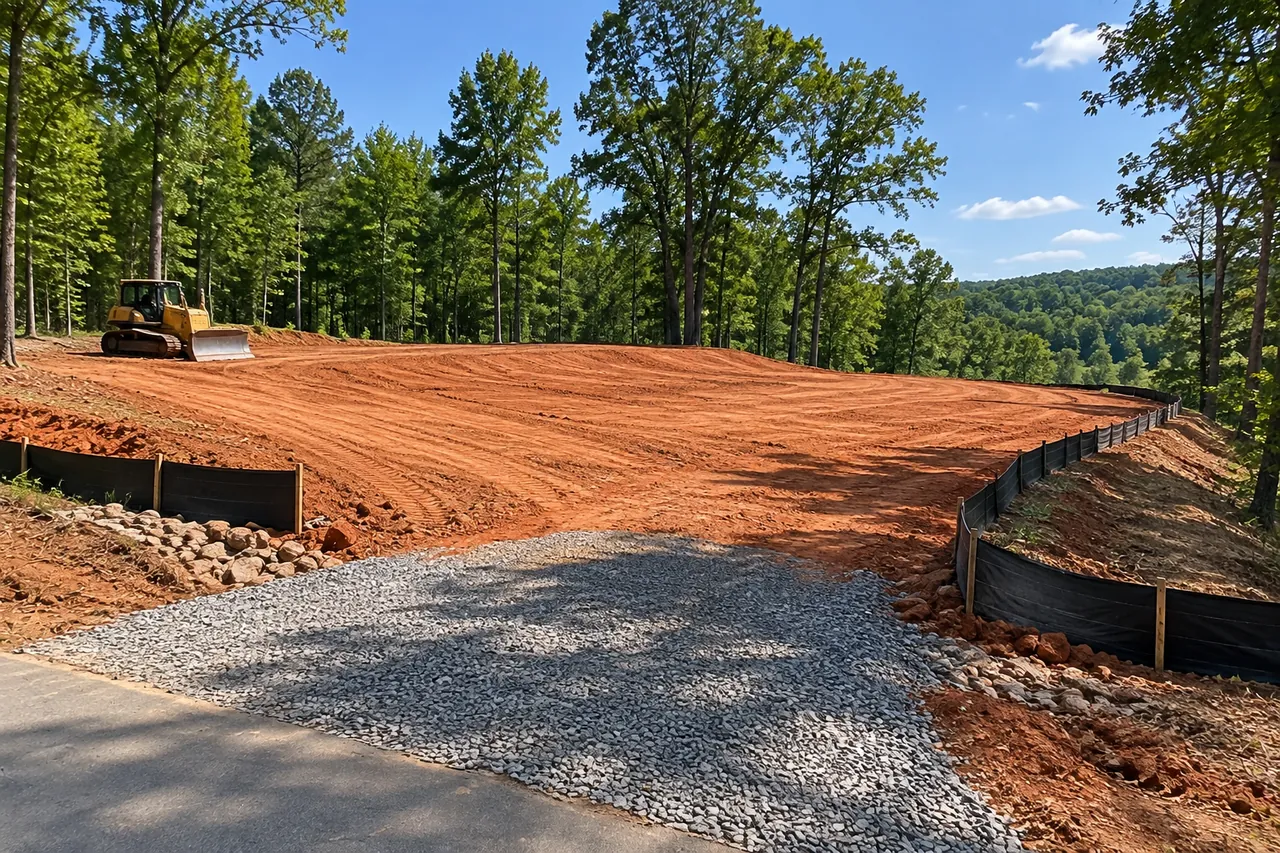
The order of operations
- Zoning. The rural districts (AR, RR, and RN) set a 1.0-acre minimum lot. Check the county zoning map or call Zoning (803-416-9777).
- Septic evaluation, if there's no sewer. It often decides where the house can go.
- Stormwater paperwork: county north of SC-5; SC DES elsewhere, and ask County Stormwater whether its rules outside the regulated area reach your parcel.
- SC811, three to twelve full working days before digging or grubbing.
- Layout: house, drive, well, and drainfield staked; keeper trees and lines flagged.
- Silt fence first on slopes that drain toward a road, a neighbor, or a creek.
- Clearing and grubbing the footprint and drive; the rest mulched or left wooded.
- Debris mulched, ground, hauled, or burned where the rules allow.
- Cover: straw and seed on bare clay as each area is finished.
Septic first, and how to clear for it
SC DES's onsite wastewater rule (R.61-56) is plain about the order: no one may begin building a house to be served by septic until DES issues the permit to construct, and a mobile or modular home can't be moved onto the site before then. Before DES evaluates the lot, you have to clear and mark the property lines and corners, put stakes at the corners of the proposed house, and mark where the tank and drainfield would go. The rule adds that you "may be required to clear underbrush" so the evaluator can get around. The evaluation fee is $150.
That points to a light first pass: mulch or brush-hog the underbrush and paths, but don't strip topsoil, grade, or run heavy machines over the likely drainfield area until DES has looked at it. The same rule asks that tree and brush removal during installation "minimizes the disturbance or loss of naturally occurring soil."
Plan the clearing around the setbacks, too. A drainfield must be at least 75 feet from a private well, 75 feet from a stream or pond, and 5 feet from a property line. Lancaster County's resource list gives the DES environmental office in Rock Hill, 803-909-7096, for perc tests and septic and well permits.
Stormwater: the lines for a house site
North of SC-5, in the county's regulated stormwater area, the county requires an Erosion and Sediment Control Permit at 10,000 square feet of disturbance and stormwater permits from 1 acre (County Stormwater Management, 803-286-3607). Most of the rural county is outside that area, where SC DES handles construction stormwater. DES asks for a notification form (DHEC Form 2628) on sites under an acre, Construction General Permit coverage for 1 to 2 acres, and a Notice of Intent over 2 acres. State law also exempts "single family residences or their accessory buildings which are separately built." If your house site will top an acre, ask SC DES whether that exemption also covers state permit coverage (DES lists its stormwater staff on its stormwater contacts page), and ask County Stormwater (803-286-3607) whether the county's rules for land outside the regulated area reach your parcel.
A worked example. An acre is 43,560 square feet. A cleared area 150 feet by 200 feet for a house, yard, and drainfield is 30,000 square feet, about 0.7 acre, before the driveway. Add a 400-foot drive cleared 20 feet wide (8,000 square feet) and you're near 0.87 acre. Long drives push rural house sites toward the 1-acre line. If a site does need state coverage, DES lists a $125 review fee plus $10 per tenth of an acre; for 3 disturbed acres that comes to $425 by our arithmetic. The permits guide has every threshold and link.
Cutting the drive through red clay and slate
Much of the county sits on the Carolina Slate Belt. Scrape off the topsoil on a typical central-county lot and you find orange-red to brick-red clay (soil series such as Georgeville and Tatum), tan-to-orange clay (Herndon), or clay with small, flat gray slate chips mixed in (Badin), per NRCS soil series descriptions. Deeper driveway cuts expose mottled red, yellow, and whitish soft weathered rock. Toward Kershaw, where the Piedmont meets the Sandhills, the ground turns to loose gray-tan sand over sandy clay.
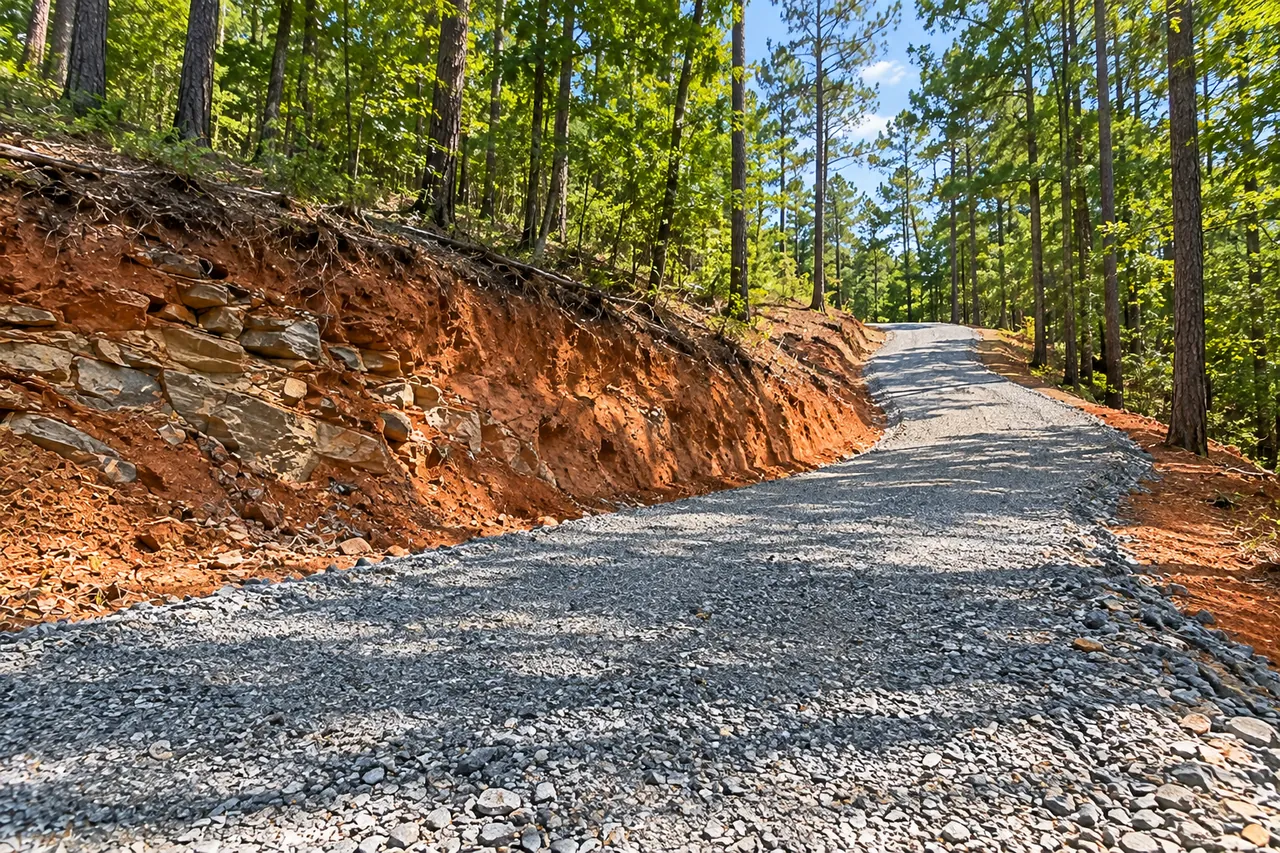
Bare clay turns to sticky red mud after rain, and silt in creeks is a listed problem in the county. A drive that follows the contour, a gravel entrance at the road, and straw and seed on cut banks as soon as they're shaped keep that clay on your land. Where a drive crosses a draw, ask Planning (803-285-6005) whether the county's stream buffers (30 to 50 feet on most streams, at least 100 feet where threatened or endangered species are present) apply to your project.
What to protect before machines arrive
- The drainfield area, once DES has looked at it. Keep machines and spoil piles off it.
- The well site, and the 75 feet between it and any septic part.
- Keeper trees. Flag them and agree in writing how close machines will work.
- Property lines and fences, especially a neighbor's pasture fence with cattle behind it.
- Creeks and wet draws. Leave the streamside trees, and keep bare ground back from the bank.
Debris on a house lot
Mulching the brush and small trees across most of the lot leaves nothing to haul. Stumps and roots under the house, drive, and any fill need to come out, and those get ground or hauled. Burning is often the hard option on a house site: SC DES allows land-clearing burns only in areas that aren't predominantly residential and at least 1,000 feet from public roads, the county bans land-clearing burns from May through September except on certain rural-zoned parcels, and construction waste from building the house can't be burned April 1 through October 30. See burning land clearing debris before counting on it.
What clearing a house site costs
National guides give a starting range. Angi (updated September 2026) prices one lightly forested acre at $500 to $2,000 and one densely forested acre at $3,600 to $5,600. For a smaller footprint, HomeAdvisor (updated June 2026) shows $125 to $500 for a lightly wooded quarter acre, or $750 to $1,400 when it's heavily forested. Because the footprint usually gets grubbed while the rest is mulched, ask for those two areas to be priced as separate lines. Then add the $150 septic evaluation and any DES fee. Treat every one of these as a national yardstick; the price for your lot comes from a contractor who has stood on it. The cost guide has more.
Does the clearing contractor need a license?
South Carolina's Contractor's Licensing Board lists "LAND CLEARING / GRUBBING" as work needing no specific license, but grading is one of its license classifications, and a general contractor license applies once regulated work costs more than $10,000. Who clears land explains the lines and how to look one up.
House site questions
How much of my lot should I clear?
Only the footprint, the drive, the drainfield area DES approves, and enough room around the house for equipment and a yard. Everything you leave wooded is ground you don't have to stabilize, seed, or mow.
Can I move a mobile home onto the land before the septic permit?
No, if it will use a septic system. R.61-56 says mobile or modular structures intended for occupancy can't be moved onto the site until DES issues the permit. Ask Zoning (803-416-9777) about placing one at all.
Should I sell the timber before clearing?
On a big wooded tract, it can offset some of the cost. But state law lets a county put off a development application for a year after a near-total harvest, so ask County Planning (803-285-6005) how that applies before you log land you plan to build on. Clearing after logging covers the rest.
How we help
Give us a call or a short request: the road the lot is on, its rough size, what's growing there, and whether DES has done the septic evaluation yet. One independent contractor who takes house-site work near you gets your request, comes out to look, and puts a price in writing. Whether to hire them is up to you. There's no charge for the referral.
Want a local contractor to walk your land?
Call or send a short request. There's no charge for the referral.