
Stump Grinding and Removal in Lancaster, SC
Stump grinding in Lancaster County can mean one big oak stump beside a house in Heath Springs or a few hundred pine stumps on cutover that's going back to pasture. Here's when grinding is enough and when a stump should be dug out, why SC811 gets a call before a grinder touches the ground, how to work around a septic system, what's left in the red clay afterward, and what stump work costs.
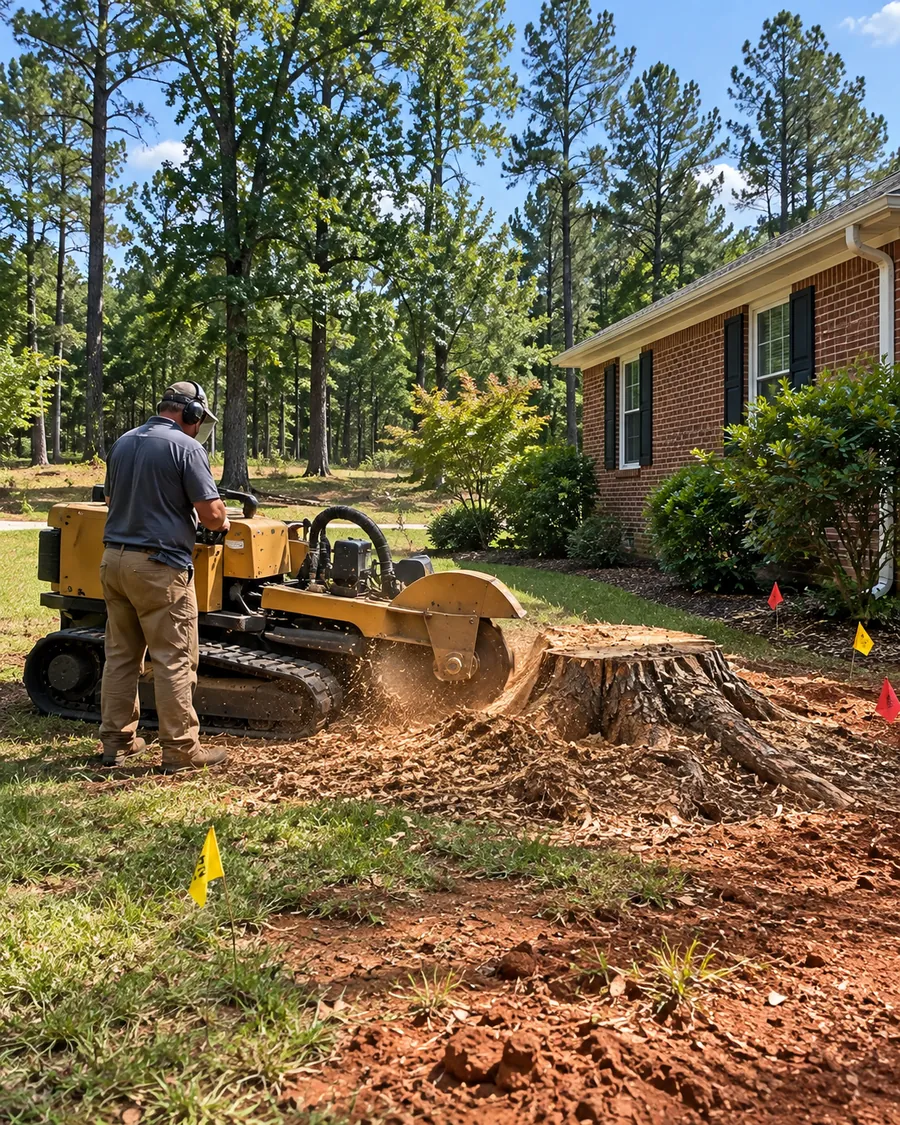
Grind it or dig it out?
Grinding chews the stump down below the surface with a spinning toothed wheel and leaves the roots in the ground to rot. It's the usual answer in a yard, a pasture, or a hay field, anywhere you just need to mow, plant grass, or stop tripping over it. The machine can be a walk-behind unit that fits through a yard gate or a larger tracked or towed grinder for big stumps and long rows.
Digging out (grubbing) uses an excavator to lift the stump and its main roots. That's what you want under a slab, a driveway, a shed pad, or fill, where buried wood would decay and leave a soft spot. It leaves a hole that has to be backfilled and compacted, and it disturbs much more soil. On a house site, the footprint gets grubbed while stumps in the yard are often just ground.
Call SC811 before the grinder starts
A grinder working below grade is moving soil, and South Carolina's damage prevention law, rewritten effective May 22, 2026, defines excavation as moving or removing "soil, earth, rock, or other materials in or on the ground by use of hand digging, mechanized equipment," among other methods (S.C. Code § 58-36-20). The statute doesn't mention stump grinding by name. But its homeowner exception covers only work with nonmechanized tools less than 12 inches deep, and a powered grinder is mechanized. The safe course is to treat grinding as excavation.
Notice must be given "within three to twelve full working days, not including the day upon which notice is given," before the work starts, and working days skip weekends and legal holidays. Call 811 or file online through SC811, and agree in writing whether you or the contractor makes the request. Also point out any buried lines you know about yourself, such as a well line or power run out to a barn.
Stumps near a septic system or well
If the house is on septic and a well, then before anyone grinds near it, find the tank, the distribution box, and the drainfield lines, and mark them. A grinder's wheel and a loaded machine's tracks can both damage shallow lines, and SC DES's septic rule (R.61-56) asks that tree and brush removal at installation be done in a way that "minimizes the disturbance or loss of naturally occurring soil." If a stump sits right on top of a line, grind it shallow or leave it, and ask the contractor how they handle it. The same goes for the well line and any buried electric to an outbuilding.
What's left in the red clay
Grinding leaves a pile of chips mixed with clay roughly where the stump was. You can rake the chips back into the hole as fill, spread them as mulch, or have them hauled. If you want grass to grow there, pull most of the chips out and fill with topsoil, because a hole full of wood chips settles as it rots and grass struggles in it.
Expect some sprouts. Grinding removes the stump, not every root, and some hardwoods come back from the roots: the U.S. Forest Service's silvics guide describes sweetgum regrowing from "root sprouts that originated from suppressed root buds." Mowing them off a few times usually settles it.
Fields and cutover full of stumps
A pasture or cutover with dozens or hundreds of stumps is a different job from a single yard stump. A forestry mulcher can cut pine stumps close to the ground across a whole field, and a grinder then takes down only the ones in the mowing path or where a fence or drive will go. Pricing usually shifts from per stump to per hour or per day. For field work, see pastures and old fields and clearing after logging.
What stump grinding costs
HomeAdvisor's national stump grinding guide (updated June 2026) lists an average of $250 and a normal range of $120 to $500. It says professionals charge "between $2 and $5 per inch of diameter," that "many contractors have a minimum fee of $100 to $150 for a single stump," and that "additional stumps may cost just $40 to $75 each."
Two worked examples, using those figures. A single 24-inch oak stump at $2 to $5 an inch comes to $48 to $120, at or below the $100 to $150 minimum, so it would likely be billed at the minimum. Three stumps would be a first stump at $100 to $150 plus two more at $40 to $75 each, or $180 to $300 (our arithmetic). Hard-to-reach stumps, hardwood, deep grinding, and hauling the chips all push it up. Use these to sanity-check a quote, not to set one; your price comes from whoever has seen the stumps.
Stump questions
How deep should the stump be ground?
Deep enough for what comes next. For grass, a few inches below grade is often enough; go deeper if you'll plant a tree or set a post there. Agree on the depth in writing, since deeper takes longer.
Can I rent a grinder and do it myself?
You can, but the same 811 notice applies to mechanized work, and the machines throw chips and rocks hard. For one or two small stumps it can make sense; for a big oak or a field of pine stumps, it usually doesn't.
Will grinding kill the roots?
It removes the stump and the top of the root mass. The rest of the roots rot in place, though some hardwoods put up sprouts first.
Do I need a permit to grind stumps?
Generally not for stumps in a yard or field. Inside Van Wyck, removing a protected tree can need a town permit unless it's a house lot or farm or forest land, and on land being developed, ask County Planning (803-285-6005) about the stream buffers. The permits guide lists who decides what.
How we help
Call or send a short request with how many stumps, roughly how big, and where they are (yard, field, or cutover). We pass it to one independent contractor who grinds or pulls stumps in your part of Lancaster County. They look them over, quote the work, and you decide. There's no charge for the referral.
Want a local contractor to walk your land?
Call or send a short request. There's no charge for the referral.