
Forestry Mulching in Lancaster, SC
Forestry mulching fits a lot of Lancaster County land. One tracked machine grinds brush and small trees into a layer of chips right where they stand, and the roots stay in the red clay to hold it in place. Nothing has to be burned or hauled. Here's how it works, where it suits the county's rolling Slate Belt ground and where it doesn't, what grows back, what it costs, and when a permit can still come up.
How it works
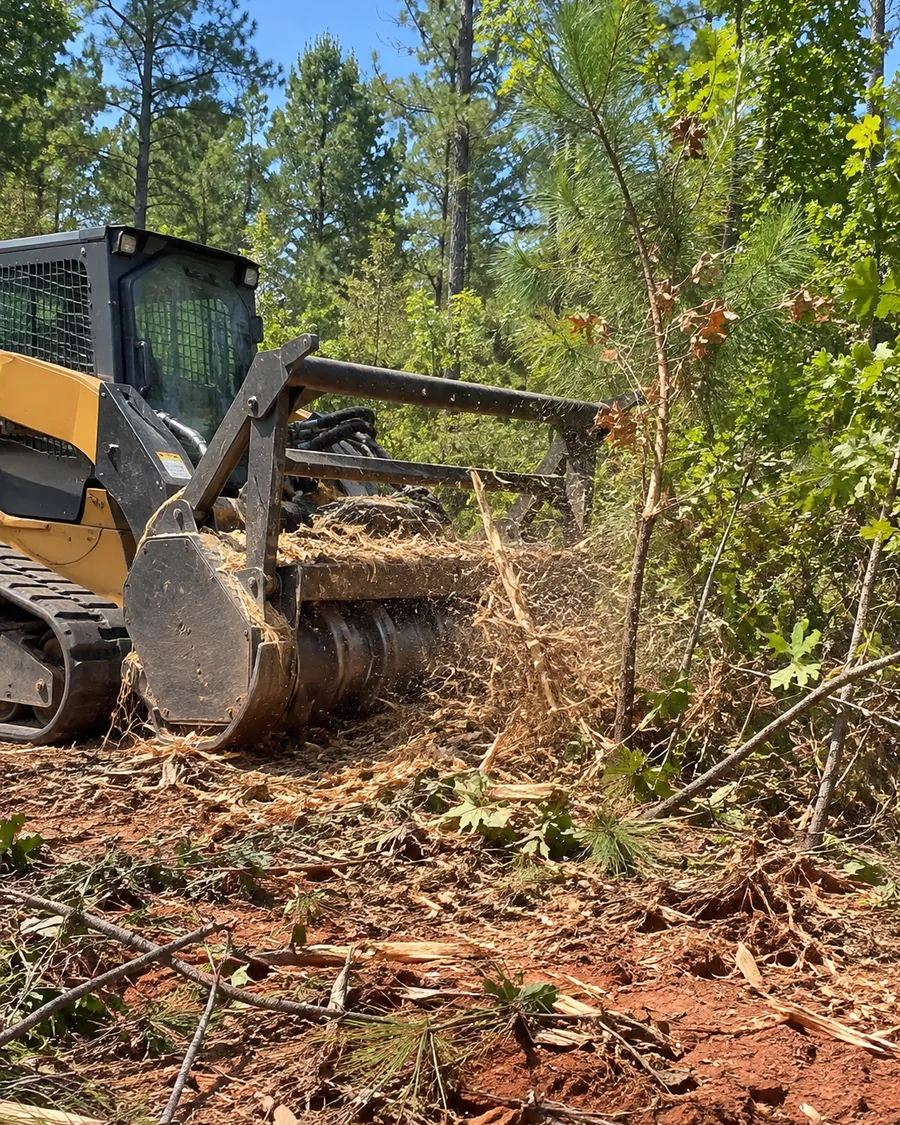
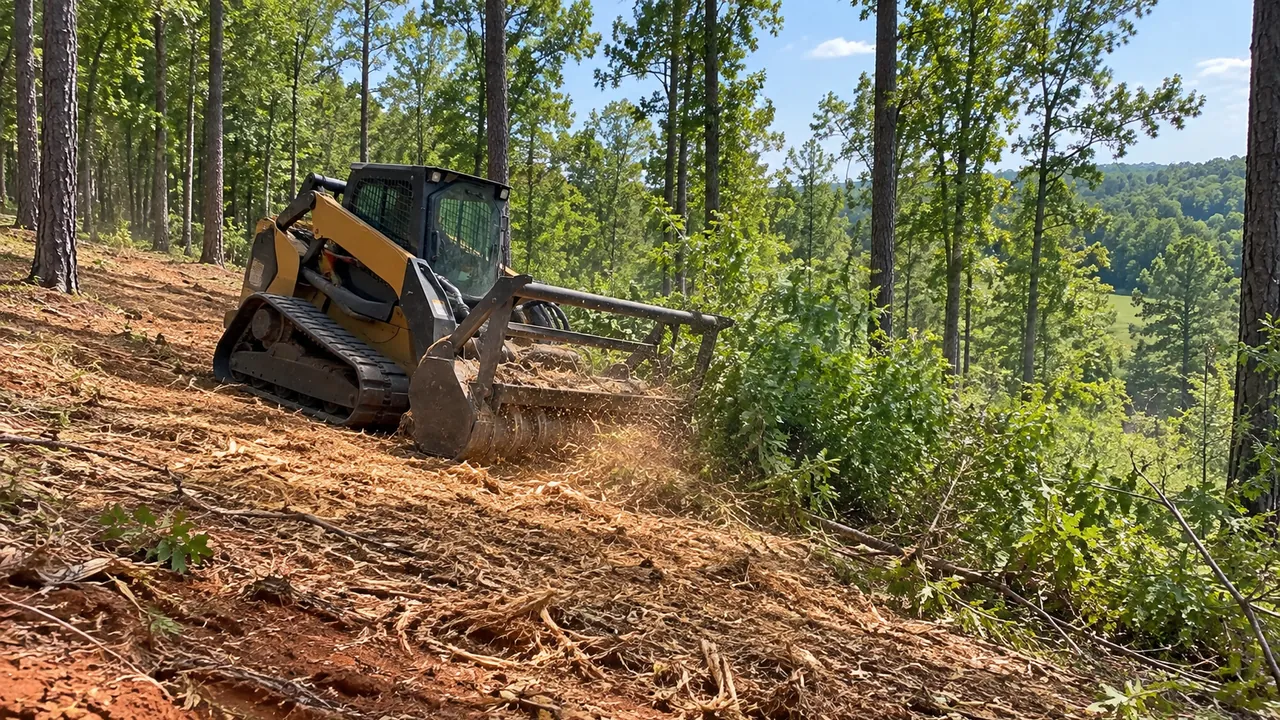
The working end is a heavy rotor studded with hardened teeth. It rides on the front of a tracked loader, on the boom of an excavator, or on a carrier built for nothing else. The machine walks up to a sapling or a cedar, lowers the spinning head onto it, and chews it down to a stump near ground level, throwing chips across the ground as it goes. One person runs the whole job from the cab, with no saw crew, no piles to burn, and no dump trucks on your drive.
Every head has a practical limit on trunk size, and it varies a lot with the machine. Ask each contractor what diameter theirs handles comfortably. Bigger trees get felled with a saw first and mulched in pieces, or that part of the job becomes conventional clearing with stumps pulled.
Why leaving the roots matters on red clay
Most of Lancaster County sits on the Carolina Slate Belt of the Piedmont: long, low ridges and creek valleys over red and orange clay. Bare clay here turns to sticky red mud after a hard rain, and silt in creeks is a listed problem in the county. Mulching helps in four ways:
- The roots stay. Nothing is pulled out of the ground, so there are no stump holes and the soil keeps its structure on a slope.
- The chip layer covers the ground. Mulch on the surface takes the first hit of a storm instead of bare clay.
- Nothing to burn. Land-clearing burns need 1,000 feet from public roads under SC DES rules, and the county bans them from May through September except on certain rural-zoned parcels. Mulching sidesteps all of it. More on burning.
- Keepers stay. An operator can work around a big white oak or a line of pines without tearing up their roots.
That matters most on land draining to Flat Creek, Gills Creek, or the Lynches River, stretches of which are federal critical habitat for the endangered Carolina heelsplitter, a mussel that needs streambeds with "no more than low amounts of fine sediment" (U.S. Fish and Wildlife Service).
What it handles in Lancaster County
- Old hay fields and pastures grown up in broomsedge, sweetgum, eastern red cedar, and young loblolly pine. Reclaiming old fields covers this in detail.
- The understory in hardwood draws and pine woods: sweetgum and red maple saplings, privet, and vines under the oaks, hickories, and yellow-poplars you'd keep.
- Thickets of Chinese privet and Japanese honeysuckle, both covered in the Forestry Commission's guide to invasive species in South Carolina forests. Brush and invasives covers follow-up.
- Fence rows, property lines, hunting lanes, and food plots.
- Slash and sprouts on cutover after a timber harvest.
- The acreage around a house site, before the footprint is grubbed.
- Scrubby turkey and blackjack oak under longleaf pine on the sandy ground toward Kershaw, where the Piedmont meets the Sandhills.
Where mulching falls short
- Building footprints. Stumps and roots left under a slab, a drive, or fill decay over the years and leave soft spots. Those areas get grubbed; the rest of the property can still be mulched.
- Saw timber. Merchantable pine and big oaks are usually more than a mulcher should take on, and on a decent stand a timber buyer may pay you for them first.
- Inside stream buffers. The county's development ordinance keeps buffers along streams, ponds, and the Catawba and Lynches rivers in natural vegetation, though it allows removing invasive species; Van Wyck adds its own 20-foot minimum along perennial streams and also adopts the county's buffer rules. Ask before mulching to the bank.
- Wet clay. Tracks rut soaked red clay. Expect a good contractor to wait out a wet spell rather than churn it.
- When you need bare soil now. Seed won't reach the ground through deep mulch until it's raked or broken down.
What grows back
Mulching cuts trees; it doesn't kill the hardwoods. The U.S. Forest Service's silvics guides say red maple "stumps sprout vigorously," with new shoots starting within 2 to 6 weeks of the cut and some reaching 3 feet or more the first year. Sweetgum comes back from its roots: after logging in the Georgia Piedmont, researchers found "as many as 40 or more stems" on the roots of a single parent tree. Plan on bush-hogging sprouts for a season or two, a follow-up herbicide treatment on the worst of them, or both. The Clemson Extension office in Lancaster (803-283-3302) can advise on follow-up for fields and woods.
What forestry mulching costs
Mulching is quoted by the acre, the day, or the machine hour. Two national guides: HomeAdvisor (updated June 2026) lists $400 to $1,500 an acre, with hourly rates from $125 to $200 for light underbrush up to $200 to $400 for thick, heavy brush. Angi (updated May 2026) lists $1,000 to $2,500 an acre, $150 to $300 an hour, and $1,200 to $2,500 for a one-acre job.
A worked example. For a 4-acre old field, HomeAdvisor's per-acre range works out to $1,600 to $6,000 and Angi's to $4,000 to $10,000 (our arithmetic). The gap is the point: density, stem size, slope, wet weeks, and the trip out decide where your land falls, so don't assume the low end of a national range fits thick growth. None of these is a Lancaster County price; what you'll actually pay is whatever a contractor writes down after walking your acres. More on cost.
Does mulching need a permit?
On farm or forest land, usually not. South Carolina's sediment law (§ 48-14-40) exempts land disturbing on agricultural land and work on forest land for producing timber. When mulching is the first step of building something, ask before the machine starts whether it counts as land disturbance under the stormwater rules: SC DES for most of the county (DES lists its stormwater staff on its stormwater contacts page), or County Stormwater (803-286-3607) north of SC-5. Keep the answer in writing. Inside Van Wyck, protected trees need a town permit unless the lot is a house lot or farm or forest land. The permits guide has the details.
Forestry mulching questions
Can the contractor work around the trees I want to keep?
Yes. Flag the keepers with tape before the contractor walks the land, and agree how close the machine will work. Mulching leaves their roots alone.
How many acres can a mulcher do in a day?
It depends on the density, the size of the stems, the slope, and how wet the clay is. Ask each contractor to estimate machine hours for your land, then compare hourly quotes using those hours.
Should I cut the trees down before the mulcher comes?
Usually not. Mulchers work best on standing growth, and trunks lying every which way slow them down. Ask before you pick up a saw.
Will the mulch keep the brush from coming back?
Not by itself. A thin layer breaks down, and sweetgum and red maple resprout through it. Follow-up mowing or treatment is what keeps it open.
How we help
Tell us by phone or with a short request where the land is, about how many acres, and what has grown up on it. We pass it to one independent contractor with a mulching machine who takes work near you in Lancaster County. They come look, put a price in writing, and the choice is yours. There's no charge for the referral.
Want a local contractor to walk your land?
Call or send a short request. There's no charge for the referral.