
Clearing Land After Logging in Lancaster, SC
Clearing land after logging in Lancaster County starts with one decision: what is the land for now? A cutover pine tract can go back into pines, become pasture, open up for hunting, or turn into a house site, and each calls for a different cleanup. Here's what a harvest leaves behind, how slash and sprouts get handled, the Forestry Commission's streamside practices, help with replanting costs, and what to budget.
Timber is a working crop here
The Forestry Commission's February 2026 county summary counts 257,233 acres of forest in Lancaster County, 73 percent of its land, and puts the delivered value of the county's 2024 timber at $17,391,819. Much of the south end of the county is pine plantation and hardwood draws, so plenty of landowners end up with a freshly cut tract and a question about what comes next.
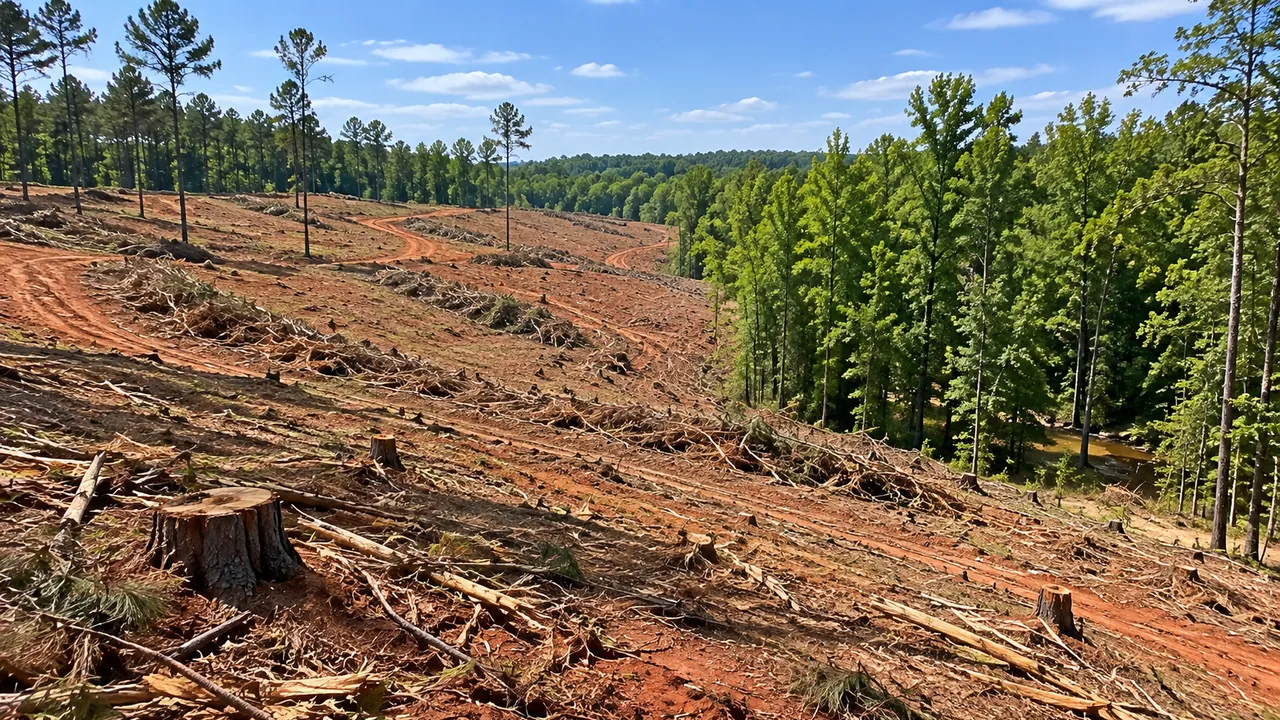
What a harvest leaves behind
- Stumps, usually in rows on a plantation, cut low but not flush.
- Slash: tops, limbs, and cull logs, scattered or pushed into windrows.
- Skid trails and decks where the red clay is bare and packed.
- Sprouts. Sweetgum comes back from the roots of cut trees; the U.S. Forest Service's silvics guide found more than 70 percent of trees of sprout origin on most plots studied after logging in the Georgia Piedmont. Broomsedge, briars, and pine seedlings follow.
The longer cutover sits, the thicker that regrowth gets and the more it costs to open up. If you know what you want, the first year or two after the harvest is the cheapest time to act.
Decide what the land is for
Back into pines. This takes the least clearing: site preparation, then planting. The Forestry Commission's cost-share programs help pay for it. The state Forest Renewal Program reimburses 40 percent of the actual cost of a practice and the federal Southern Pine Beetle Prevention program 50 percent, each capped per acre. For 2026 to 2027, the caps for medium or heavy mechanical site prep are $143 per acre (FRP) and $179 (SPB), and $60 and $75 for planting loblolly. The FRP brochure sets a minimum of 10 contiguous acres and says "applications should be submitted prior to May 15th." Funding is limited, and the Commission says not to start work before approval.
Pasture or hay. Stumps have to be ground low or pulled where mowers and balers will run, and the clay needs lime, seed, and time. Pasture and old field clearing covers the farm side.
Hunting land. Often the lightest touch: mulch lanes and a few food plots, and let the rest grow up as cover.
A house site. South Carolina's 2009 forestry law lets a county put off a development application for one year after a harvest that removed all or substantially all of the trees, or five years if the harvest willfully broke county rules. Ask County Planning (803-285-6005) how that applies before you plan to build, then start with the septic evaluation. Clearing a house site walks through the order.
Slash, windrows, and stumps
A forestry mulcher can grind scattered slash, sprouts, and low stumps in one pass and leave the chips on the clay, which keeps skid trails from washing. Windrows packed with dirt and big stumps are harder; they may need an excavator to spread or pile them for grinding.
Burning is the other option. SC DES's land-clearing rule (R.61-62.2) requires "all salvageable timber and pulpwood" to be removed first, the piles to be at least 1,000 feet from public roads, and dirt on the material kept to a minimum, which is hard with pushed-up windrows. For a prescribed or forestry burn, notice goes to a Forestry Commission dispatcher at 1-800-777-3473, and the Commission's smoke guidelines say "Notifications will be accepted only on the day of the burn." Burning land clearing debris has the rest.
Keep machines out of the streamside zones
The Forestry Commission's BMP manual calls for a primary streamside management zone "40 feet wide on each side of the stream" along perennial and intermittent streams, with at least 50 square feet of basal area per acre left along perennial streams. The practices are voluntary, but the Commission notes they "can also prevent violations of the US Clean Water Act." Cleanup can undo that zone if a mulcher or dozer works the slash right up to the bank, so flag it before the machine arrives.
It matters more here than in most counties. Stretches of Flat Creek, Gills Creek, and the Lynches River are federal critical habitat for the endangered Carolina heelsplitter, a mussel that needs streambeds with little fine sediment. And if the tract is being turned into something other than timber, the county's development ordinance buffers (30 to 50 feet on streams draining more than 20 acres, 100 feet on the Catawba and Lynches and wherever threatened or endangered species are present) may apply instead; ask Planning. The BMP manual also warns against "Using silvicultural exemptions to try to achieve non-silvicultural objectives."
What cutover cleanup costs
National guides price this as mulching or clearing. Angi (updated May 2026) gives $1,000 to $2,500 an acre for forestry mulching, and HomeAdvisor (updated June 2026) $400 to $1,500. Fresh cutover with small sprouts sits differently from a stand of 10-year regrowth, and windrows, stump height, and slope all move the number. Neither guide is a Lancaster County price; ask for a written per-acre or per-day figure after the contractor has walked the tract.
A worked cost-share example. How the caps work. FRP pays 40 percent of your actual cost for medium or heavy mechanical site prep, up to $143 an acre, so the cap takes over once that work costs more than about $358 an acre ($143 ÷ 0.40). SPB pays 50 percent up to $179 an acre, which also tops out at about $358 an acre ($179 ÷ 0.50) (our arithmetic). Below that you get the percentage; above it, the cap.
After-logging questions
The logger left a mess. Who can I talk to?
Start with your timber sale contract. The Forestry Commission's BMP page also has a link for reporting concerns about a logging job, and its office serving Lancaster County, in Patrick, is at 843-498-6918.
Do I have to replant?
Ask the Forestry Commission office (843-498-6918) whether anything applies to your tract. Its landowner pages describe cost-share help for replanting.
Who can help me plan the next stand?
The Forestry Commission keeps a list of consulting foresters, each of whom must employ a registered forester. The Commission's project forester for Lancaster County is at 803-713-1020, and Clemson's area forestry and wildlife agent at 803-572-8491.
Is it worth cleaning up land I'm only going to hunt?
Usually only in strips: lanes, a road, and a few plots. The rest can grow up as cover.
How we help
Phone us or send a short request with where the tract is, how many acres were cut, when, and what you want it to become. We hand it to one independent contractor who cleans up cutover in your end of the county. They walk it and quote it in writing, and the call is yours. There's no charge for the referral.
Want a local contractor to walk your land?
Call or send a short request. There's no charge for the referral.