
Pasture and Old Field Clearing in Lancaster, SC
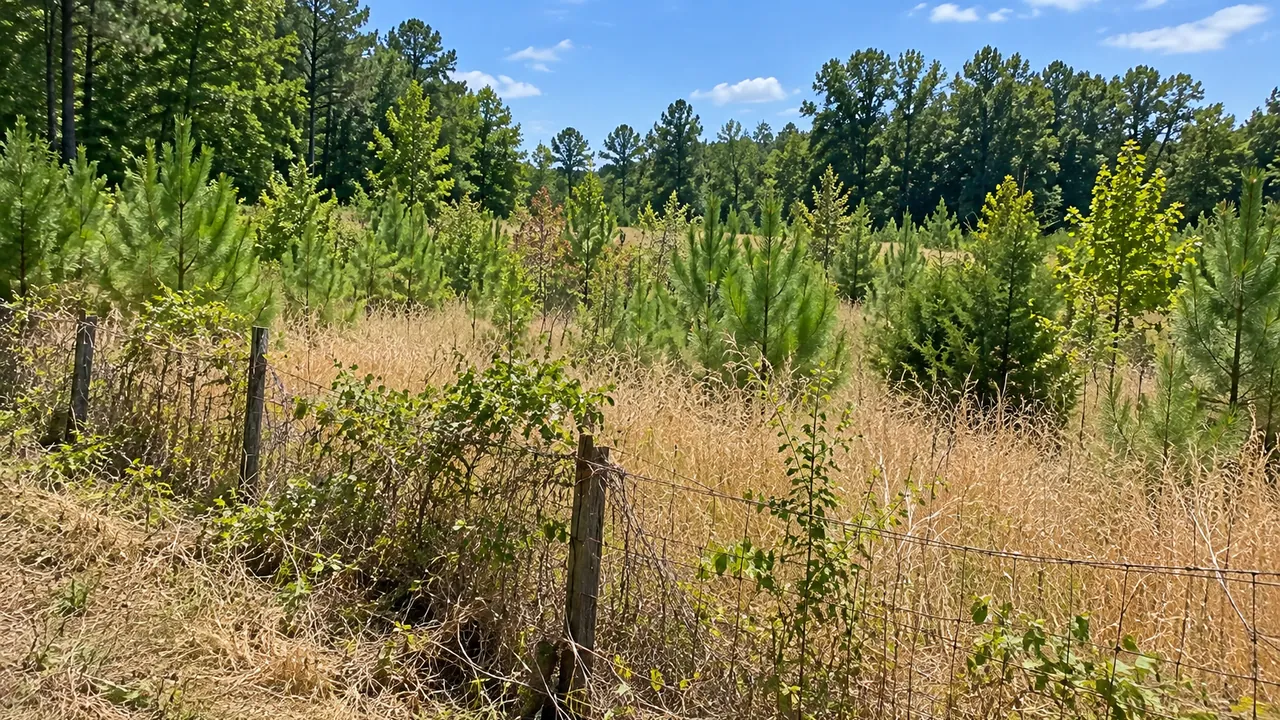
Clearing an old pasture or hay field in Lancaster County usually means taking back ground that sat a few seasons too long: broomsedge first, then sweetgum, red cedar, and loblolly pine coming up through it. Here's how to get it back into grass, how to handle the fence rows, when a mulcher beats a bush hog or a root rake, where to get planning help and cost-share, and what the work costs.
Hay and cattle land is still a big part of the county
The 2022 Census of Agriculture counted 510 farms in Lancaster County on 60,781 acres, an average of 119 acres each. They held 17,878 acres of pastureland and 9,419 acres of hay and haylage, and 9,382 cattle and calves, with livestock and poultry making up 91 percent of farm sales. When a field sits unmowed for a few years, it starts filling in.
How an old field fills in
Leave a Piedmont field unmowed and the sequence is predictable. Broomsedge takes over first, then goldenrod and Japanese honeysuckle, then woody sprouts: sweetgum, winged elm, eastern red cedar, and loblolly pine. A study of old fields by the Hilton Pond Center in neighboring York County describes them becoming young pine woods in 20 to 30 years. The practical upshot is cost: a field caught at the broomsedge-and-sapling stage is a mowing or light mulching job, while one with 15-foot cedars and pines is a real clearing job.
Bush hog, mulcher, or root rake?
- Bush hog (rotary cutter). Fine for broomsedge, briars, and small saplings. It leaves stubs that resprout, and it bogs down once stems get thick.
- Forestry mulcher. Takes cedars, pines, and sweetgums that are too big for a bush hog, cuts them near the ground, and leaves the roots in the clay. It's the usual choice for a field you'll graze or hay without tilling. How mulching works.
- Root raking or grubbing. Pulls stumps and roots so the ground can be disked, tilled, or smoothed for hay equipment. It costs more and leaves bare soil that can wash on a slope, so it's worth doing only where you need it.
- A mix. Many fields get mulched across the top, with only the worst stumps ground or pulled where a mower or baler will run.
Fence rows
Fence rows are where fields go first. Birds perch on the wire and drop seed, and the Forestry Commission notes that "Privet is widely disseminated by many birds and other wildlife species that consume the fruit." In a few years a single wire becomes a wall of privet, cedar, and honeysuckle. A mulcher can open a strip along each side of the wire and leave the big shade oaks standing.
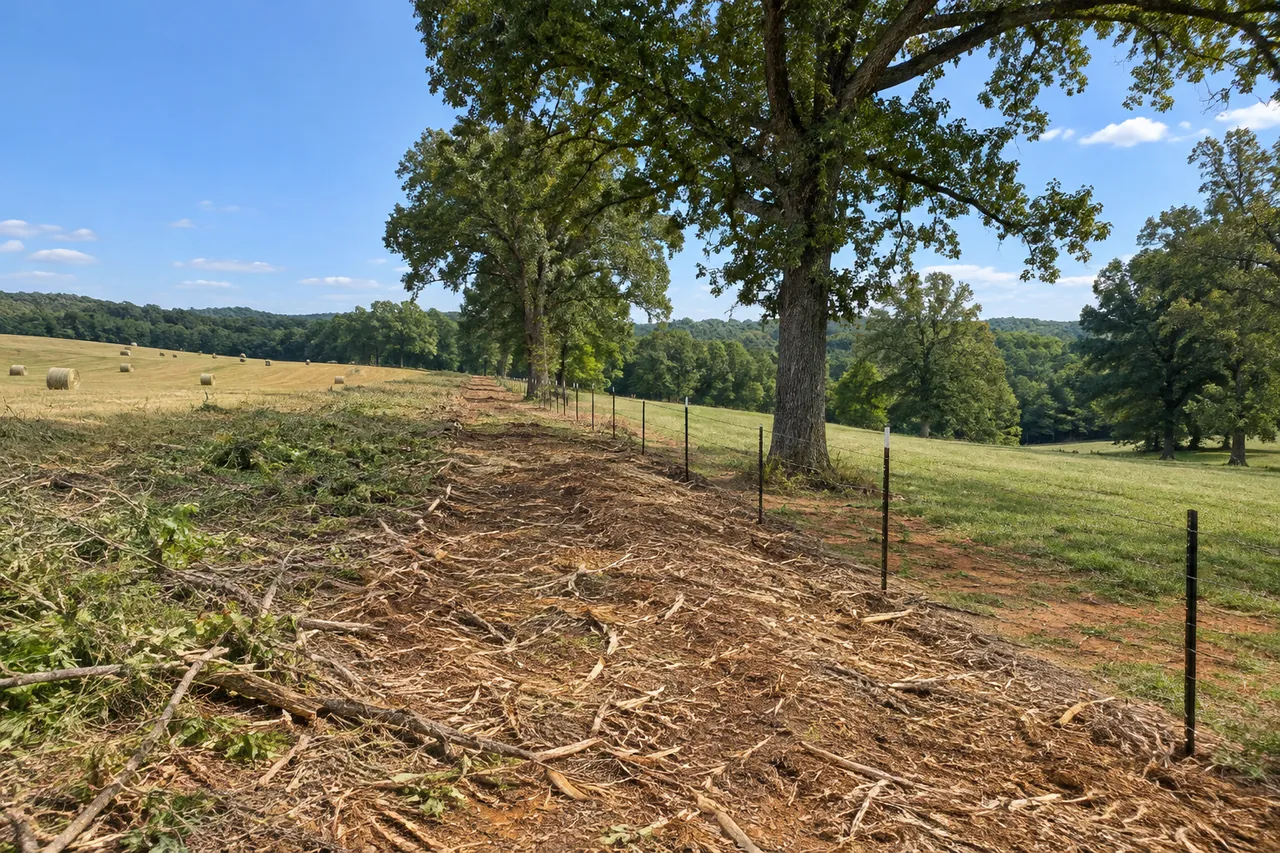
Before the machine comes, walk the line and mark old wire, buried posts, and any wire grown into trees, and tell the contractor where they are. Agree on which side of a boundary fence the work stays, and talk to the neighbor first if the fence is shared.
Getting grass back, and who can help
Clearing is the first step; the field still needs a stand of grass. Ask the Clemson Extension office in Lancaster (305 N. Catawba St., 803-283-3302) about soil testing and forage choices before you lime and seed. Its area livestock and forages agent is reachable at the same number.
USDA's Natural Resources Conservation Service offers EQIP, which "provides financial and technical assistance to agricultural producers and non-industrial forest managers." Applications are taken year-round, but NRCS says to apply by the state's ranking dates. NRCS practice standards include Brush Management (314), Pasture and Hay Planting (512), and Grazing Management (528). Its South Carolina payment schedule for FY26 lists payment scenarios for brush management and pasture planting but not for Land Clearing (460). Locally, the Lancaster Soil and Water Conservation District (1771 Highway 521 Bypass South, (803) 286-4455, extension 7501) can point you to NRCS cost-share programs, and the NRCS South Carolina State Office in Columbia is at 803-253-3935. Talk to them before you clear: the Forestry Commission tells landowners not to start work before approval on its own cost-share programs, and it's worth asking NRCS the same question.
Keeping it open
Sweetgum is the stubborn one. The U.S. Forest Service's silvics guide describes it regrowing from root sprouts, with more than 70 percent of trees of sprout origin on most plots it studied after logging in the Georgia Piedmont. Expect sprouts the first summer after clearing. Regular mowing, good grazing management, and spot treatment of the worst sprouts keep a reclaimed field from sliding back.
Permits for farm clearing
South Carolina's sediment law (§ 48-14-40) exempts "Land disturbing activities on agricultural land for production of plants and animals useful to man," so reclaiming a pasture or hay field is generally exempt from the state's Stormwater Management and Sediment Reduction Act. If the field is really being cleared for house lots or a building, that exemption doesn't fit. Along creeks, leave the streamside trees; on development projects, the county's ordinance keeps buffers of 30 to 50 feet on streams draining more than 20 acres and at least 100 feet where threatened or endangered species are present, and stretches of Flat Creek, Gills Creek, and the Lynches River carry an endangered mussel that silt harms. The SC811 law excludes farm tilling or plowing less than 12 inches deep, but pulling stumps with a machine moves soil, which fits the law's definition of excavation, so call 811 first. Farm burns authorized by the Forestry Commission fall outside the county's burning ordinance, but state notice and SC DES rules still apply. The permits guide has the details.
What field clearing costs
The guides below are national, not local. Angi (updated May 2026) has forestry mulching at $1,000 to $2,500 an acre; HomeAdvisor (updated June 2026) has $400 to $1,500 an acre, or $125 to $200 per hour where the growth is mostly saplings and underbrush. Once a field has turned into real woods, Angi's land clearing guide (updated September 2026) gives $500 to $2,000 for a lightly forested acre and $3,600 to $5,600 for a dense one. As a worked example, a contractor who estimates ten machine hours for your field at HomeAdvisor's $125 to $200 hourly range would come to $1,250 to $2,000 (our arithmetic, before travel or minimums). Your own quote depends on stem size, slope, fence rows, and how far the machine travels. More on cost.
Old field questions
Do I need a permit to clear my own hay field?
Usually not, if it stays in farming: state law exempts land disturbing on agricultural land. Keep clearing back from creek banks, and call 811 before any machine digs out stumps.
Should I just let it grow into pines?
That's a real option on land you won't farm. The Forestry Commission's Forest Renewal Program helps pay for "Site preparation and tree planting on previously forested or agricultural lands" on at least 10 contiguous acres. Clearing after logging covers replanting help.
Can stumps stay in a hay field?
Low stumps are a hazard to mowers and balers. Many owners mulch the field and have the stumps in the mowing path ground below the surface. Stump grinding explains the options.
What about the cedars along the fence?
Keep a few big shade trees if the cattle use them, and clear the rest of the row. Privet left along the wire keeps seeding the field, since birds spread its fruit.
How we help
Call or send a short request with where the field is, roughly how many acres, and what's grown up in it. We connect you with one independent contractor who clears pasture and hay ground in your part of Lancaster County. They walk the field and give you a quote, and you decide. There's no charge for the referral.
Want a local contractor to walk your land?
Call or send a short request. There's no charge for the referral.